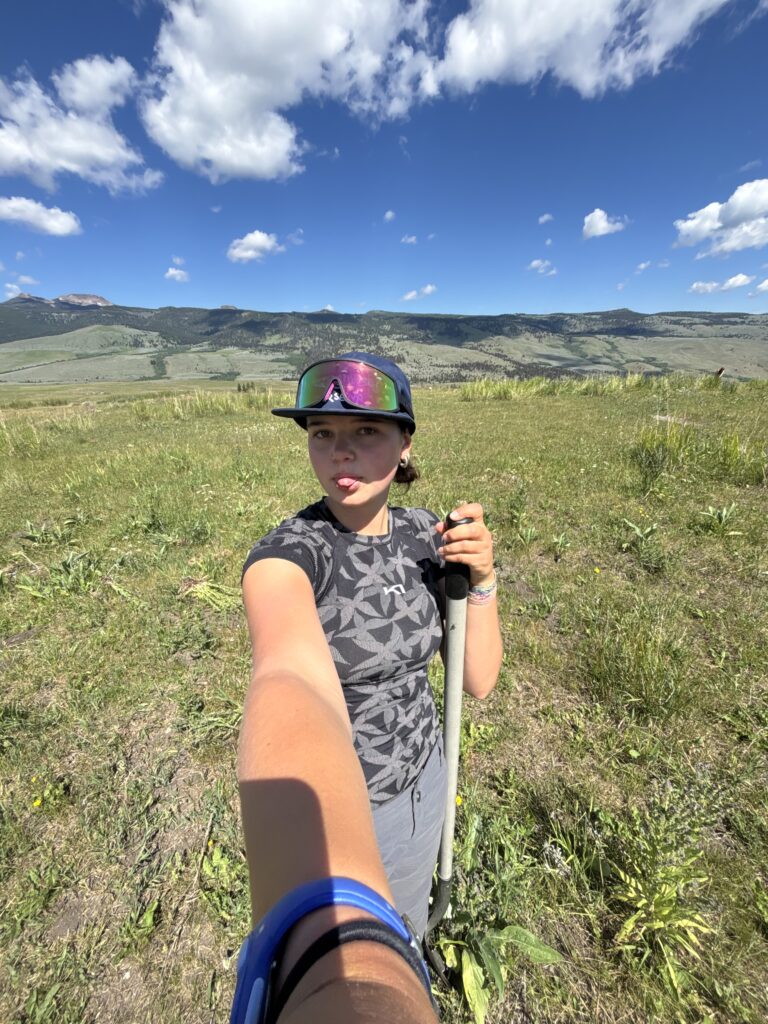
Midway through my WRFI trip, our group spent a night at Red Rock Lakes National Wildlife Refuge. After we made dinner and watched a spectacular sunset, one of my peers and I headed down to the lakeshore for a final glimpse at the pink and orange painted sky. We stood in silence and stillness for a long time. Our peaceful nature blended us in with the surrounding environment, so much so that a Sandhill Crane soared across the water and landed about 50 feet away from us. In silence, still, we watched each other. I truly have no concept of how much time passed, but, after a long while, some bats decided to join us in our silence. They swarmed down from the trees and circled our heads. I felt the air from their wings on my cheeks, yet we remained still and silent. It was the closest to nature I have ever felt.

Reflecting back on this experience, I am reminded of one of the first discussions that we had on this course. We had just read, “The Big Lie” by Eric Katz, in which Katz defined the term “natural.” He wrote that “natural individuals were not designed for a purpose.” This article led us into a long discussion of what makes something “natural.” At what point does a restored environment become “natural”? Are humans “natural”? Then, is all restoration technically “natural,” because it was created by humans, who arguably, are “natural”? And so on and so forth.
I bring this up because back with that Sandhill Crane and those bats and that sunset, I felt the most natural I had ever felt. And somehow, also the most human.
I understand both sides of the “are humans natural” debate. I understand the unnatural argument in the context of the words of Robin Wall Kimmerer. In her essay, “Returning the Gift,” she brings up the term “species loneliness.” As so-called human dominance has grown, we have become more and more isolated from the creatures that we used to call neighbors. So, I can understand how we’d feel unnatural, in that sense.
However, I affirm my belief that humans are in fact natural, again with the words of Robin Wall Kimmerer. In that same essay, she writes that we are all governed by the same ecological and evolutionary rules. We are much closer to the more-than-human world than the myth of human exceptionalism leads us to believe. Kimmerer argues that our relationship with the land is broken, that our capitalistic society has raised us under the false assumption that we are, and we should be, the dominant forces on this planet.
All of this being said, I truly believe that humans are natural. I believe that this understanding is crucial in repairing our relationship with the more than human world. My experience with that Sandhill Crane, those bats and that sunset, brought me a step closer to my neighbors in the natural world.