When
Where
This course takes place in western and central Montana on successive explorations of the Bob Marshall Wilderness, the Blackfeet Reservation, the Missouri River, Fort Belknap Reservation, Yellowstone National Park, the Northern Cheyenne Reservation, and the Tongue River Basin in southeastern Montana. The course begins and ends in Missoula, Montana.
Permitted activity takes place on the Helena-Lewis & Clark National Forest and the Upper Missouri River Breaks National Monument.
Semester Credits
15 Total Semester Credits/22.5 Total Quarter Units:
Academic Credit:
All courses offered through the Wild Rockies Field Institute are accredited through the University of Montana. Each Wild Rockies Field Institute course is approved and supported by University of Montana departmental leadership and faculty.
The “Montana Afoot and Afloat” semester offers five independent courses, each worth 3 semester credits, for a total of 15 credits earned for successfully completing the program.
Quarter System Students:
For colleges and universities on the quarter system, each of the five courses is typically worth 4.5 quarter system units, for a total of 22.5 units upon successful completion of the program.
Block System Students:
At institutions where one course is equal to one credit, each class (e.g. CCS 391) within a WRFI course is typically equal to one credit.
Montana Afoot and Afloat Course Description
The course is split into four sections, each lasting between 12-15 days. Approximately one half of the course is spent in the backcountry, traveling across the landscape. When the group is not traveling in the backcountry they will visit small towns and meet with a variety of local citizens, land managers, scientists, elected officials, farmers, recreationists, and ranchers. These guest speakers expose students to diverse perspectives on the landscapes and cultures of the area.
The days between sections are also used to re-supply the course with food and other supplies. Typically, students have the opportunity to receive mail, check email, take showers, buy personal food and do laundry between each section. There is a course recess approximately half way through this course in which students and instructors get a brief break from the rigors of traveling and academics.
Section One: Bob Marshall Wilderness | Backpacking & Site Visits
Students begin their exploration backpacking in the famed Bob Marshall Wilderness, one of the largest wildernesses in the continental United States. Meetings with land managers and tribal members living on the neighboring Blackfeet Reservation provide perspectives on a variety of public lands management issues.
Section Two: Missouri River | Kayaking & Site Visits
The Missouri River in north central Montana has a rich cultural heritage and provides students the opportunity to delve into the historical context and contemporary realities of the area while kayaking over one-hundred miles through the Upper Missouri River Breaks National Monument to the Charles M. Russell National Wildlife Refuge. Students will learn about bison reintroduction efforts through service project with American Prairie Reserve and meetings with guest speakers on the Fort Belknap Reservation.
Section Three: Yellowstone Ecoregion Uplands | Backpacking & Site Visits
This section begins with an autumn backpack in the Big Snowy Mountains, an Island Range that emerges out of Montana’s eastern plains. In addition to several site visits in the area exploring rural livelihoods and energy production, the students will also visit Yellowstone National Park with an academic focus on public lands management and the unique environmental geography of the Greater Yellowstone Ecoregion.
Section Four: Tongue River & Neighboring Communities | Kayaking & Site Visits
The final section of the course takes the group back to plains and into the kayaks, this time to the Montana border with Wyoming and the headwaters of the Tongue River. The second half of this section connects local to global perspectives through site visits to neighboring Native American Reservations, ranches, and coal production facilities in the continuing quest to explore varied perspectives on human/land relations.
In addition to the academic topics mentioned above, throughout the course students learn and cultivate skills in wilderness travel, minimum impact camping, orienteering, and natural history.
PRE/POST-COURSE WORK:
One week of remote coursework before and five weeks after the field portion of the course entails participating in a peer-review process aimed at helping students complete their final cumulative assignment.
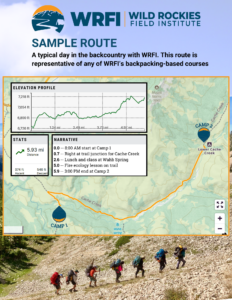
Sample Backpacking Daily Itinerary